Being Bold in Driving Parent Engagement
Strong home school partnerships sit at the heart of everything we do in education. When families and schools work together, children benefit academically, socially, and emotionally. Most educators believe this deeply. Living it consistently, across a diverse community, is where the real challenge lies.
In international school contexts in particular, parent engagement can be complex. Our communities are made up of families with different cultures, languages, educational experiences, and expectations of schools. What feels supportive and proactive to one family may feel unfamiliar or even uncomfortable to another. Navigating this well requires care, trust, and intentionality.
Traditional approaches to engaging parents still matter. Parent teacher conferences, open evenings, curriculum workshops, and student performances all play an important role in building relationships and shared understanding. They provide structure, predictability, and reassurance. However, if these are the only ways we engage families, we can miss opportunities to build something deeper.
Sometimes, the most meaningful progress comes when we are brave enough to be bold. When we step slightly outside our comfort zone, rethink our approach, and try something new, we create space for more authentic connection.
Recently at KIS, we hosted a parent workshop focused on online safety. On the surface, this is not unusual. Many schools run sessions on digital wellbeing, screen time, or online risks. What made this experience different was how we positioned the conversation.
Rather than presenting a list of rules, recommendations, or actions that parents should take, we approached the evening as partners. We acknowledged openly that online safety is complex, fast changing, and something we are all still learning to navigate. As a school, we do not have all the answers, and neither do families. That honesty mattered.
We selected topics we knew were important to our community, including some that feel uncomfortable or confronting. We then created space for discussion rather than instruction. Our role as educators was to facilitate, listen, and learn alongside parents, not to lecture or prescribe.
Our staff were exceptional in this role. They created a calm, respectful environment where parents felt safe to share concerns, ask questions, and admit uncertainty. In return, our parents showed up with courage, openness, and generosity. Conversations were thoughtful, supportive, and grounded in a genuine desire to do the best for our children.
One of the most powerful elements of the evening was the involvement of our students. Some of our 17 to 18 year olds took part as facilitators, sharing their perspectives and experiences of the online world. Their contributions added depth, honesty, and relevance that adults alone could not provide. For many parents and staff, hearing directly from young people was both eye opening and reassuring.
Did we leave the workshop with a complete solution to online safety? No. And that was never the goal.
What we did leave with was a stronger sense of community, a clearer understanding of each other’s perspectives, and a shared commitment to ongoing dialogue. We reinforced the idea that supporting children in this space is a shared responsibility, not something that sits solely with schools or families.
This experience reminded us that meaningful parent engagement is not about having all the answers. It is about building trust, showing vulnerability, and being willing to learn together. It requires courage from schools and from families, and it flourishes when everyone feels respected and heard.
As educators and leaders, we should continue to ask ourselves how bold we are being in our engagement with our communities. Are we relying only on familiar structures, or are we creating new opportunities for genuine partnership?
If we are willing to be braver in how we engage parents, we can build stronger, more connected communities around our children. And that is work worth doing.
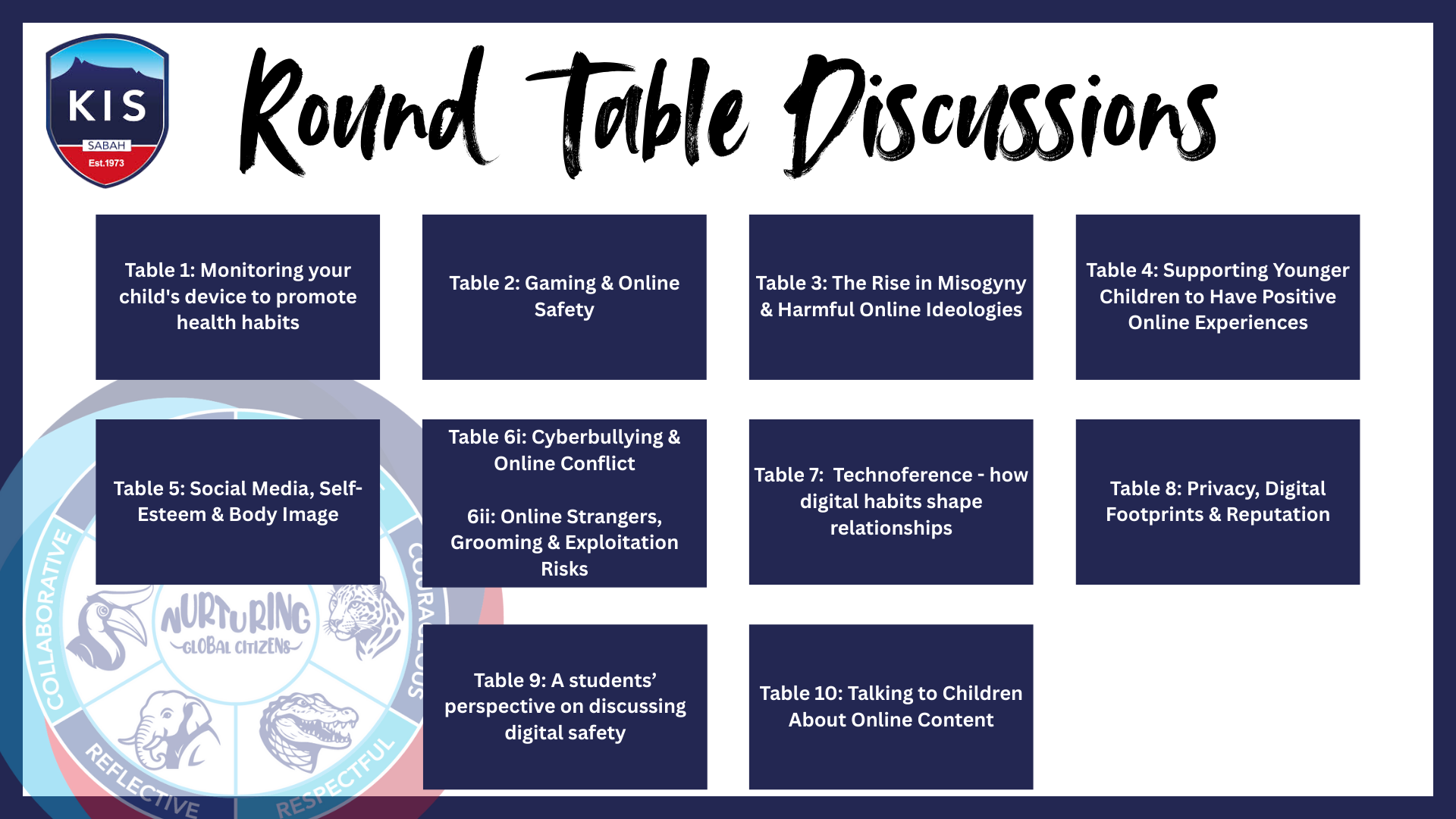
The topics we had for our round table discussions, facilitated by a mixture of our safeguarding team, extended leadership team, students and parents - we didn’t shy away from the tough topics but instead leaned into the need to make space for these conversations
